
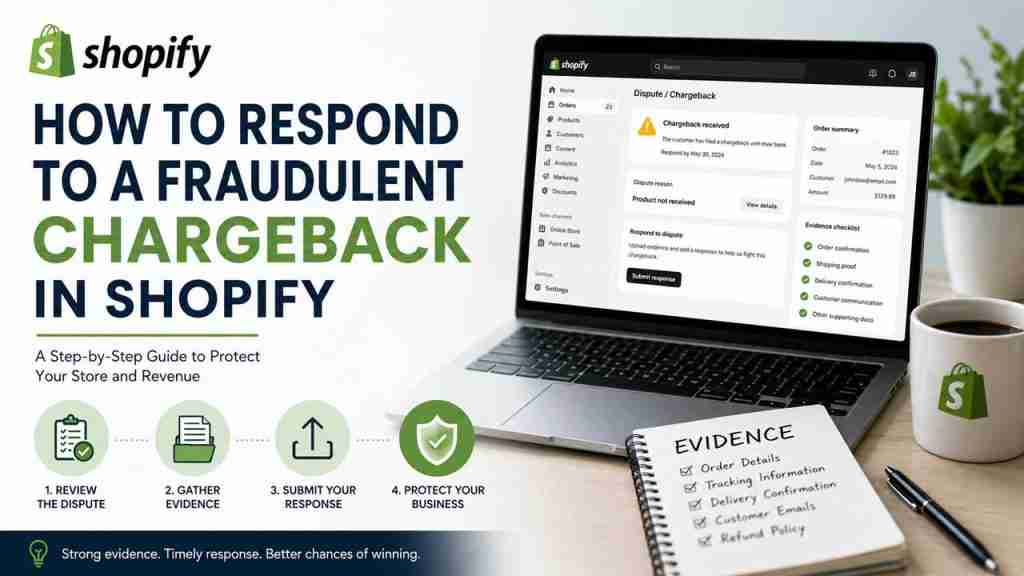
Chargebacks are a costly and often frustrating part of ecommerce. While many disputes stem from legitimate issues, a growing share comes from “friendly fraud” — customers who knowingly or unknowingly dispute valid transactions. For Shopify merchants, responding quickly and professionally is essential to protecting revenue and maintaining a healthy payment profile.
This streamlined guide explains how chargebacks work in Shopify, how to assemble strong evidence, and how to reduce future disputes.
DOWNLOAD SHOPIFY CHARGEBACK DISPUTE CHECKLIST

What a Chargeback Is — and Why It Matters
A chargeback begins when a customer disputes a transaction with their bank. The bank reverses the payment temporarily, credits the customer, and requests evidence from the merchant. Shopify alerts you through email and your Admin dashboard, and you must respond before the deadline or the case is automatically lost.
Common dispute categories include unauthorized transactions, non-delivery, product dissatisfaction, duplicate charges, and refund disputes. Each requires different evidence, so identifying the correct category is the first step.
Understanding Friendly Fraud
Friendly fraud occurs when a legitimate customer disputes a valid purchase. It often involves claims of non-delivery despite tracking confirmation, forgotten purchases, unauthorized family use, or intentional abuse of the dispute system. These cases are difficult but winnable with strong documentation.
Step 1: Locate the Chargeback
In Shopify Admin:
- Go to Orders
- Open the disputed order
- Review the Chargeback or Inquiry section for the reason and deadline
Step 2: Review the Dispute Reason
Knowing the dispute type determines what evidence you need. For example:
- Fraudulent: Prove the customer participated in the purchase
- Product Not Received: Provide tracking and delivery confirmation
- Product Unacceptable: Show accurate product descriptions and customer communication
- Credit Not Processed: Provide refund records
- Duplicate Transaction: Show only one charge was valid
Step 3: Gather Strong Evidence
Banks move quickly, so your evidence must be clear and complete. Collect:
Order Data: Customer information, billing and shipping addresses, IP logs, order timestamps.
Shipping Proof: Tracking numbers, delivery scans, signatures, carrier confirmations.
Customer Communication: Emails, chat transcripts, support tickets.
Product Documentation: Descriptions, photos, policies, terms of service.
Fraud Screening Data: AVS/CVV results, device fingerprints, geolocation data.
Step 4: Present Evidence Clearly
Organize your response chronologically so the bank can understand the sequence at a glance. A simple timeline — order placed, payment authorized, item shipped, item delivered, customer communication, dispute filed — strengthens your case.
Step 5: Submit Your Response in Shopify
Inside the disputed order:
- Select Submit Response
- Upload your evidence
- Add a concise written explanation
- Submit before the deadline
Late submissions are automatically denied.
Step 6: Write a Professional Rebuttal
Your rebuttal should be factual, brief, and free of emotion. A strong structure includes:
- Transaction Summary: What was purchased and when
- Fulfillment Evidence: Tracking, delivery, signatures
- Customer Participation: Emails, logins, account activity
- Conclusion: Why the dispute is invalid based on the evidence
Step 7: Use Delivery Confirmation Whenever Possible
For physical goods, delivery confirmation is your strongest defense. Tracking screenshots, GPS scans, signature records, and delivery photos carry significant weight with banks.
Step 8: Understand the Review Timeline
After you submit your response:
- Shopify forwards your evidence to the processor
- The processor sends it to the issuing bank
- The bank reviews both sides and issues a decision
This process can take weeks or months. Even strong cases can be denied, especially in fraud-related disputes, but thorough documentation improves your odds.
Step 9: Why Merchants Win or Lose
Merchants win when:
- Delivery is confirmed
- Customer communication shows participation
- Billing and shipping addresses match
- AVS/CVV checks succeed
Merchants lose when:
- Delivery proof is missing
- No response is submitted
- Documentation is incomplete
- Digital products lack usage logs
Step 10: Prevent Future Chargebacks
Prevention is more effective than fighting disputes.
Use Fraud Tools: Monitor high-risk indicators, mismatched addresses, VPN usage, and failed attempts.
Require Signatures for High-Value Orders: Adult signatures, insured shipping, and package photos reduce risk.
Maintain Clear Policies: Refund, shipping, and return policies should be easy to find and understand.
Improve Customer Service: Fast responses and clear communication prevent disputes from escalating.
Use Clear Billing Descriptors: Ensure customers recognize your business name on their statements.
Block Repeat Offenders: Track emails, addresses, and IPs of customers who repeatedly file disputes.
Digital Products Require Different Evidence
Since there’s no physical delivery, rely on:
- Login timestamps
- Download logs
- IP address records
- Usage analytics
- Account creation data
For subscriptions, keep records of login activity and cancellation attempts.
Shopify Protect
Some Shopify Payments orders qualify for Shopify Protect, which reimburses merchants for certain fraudulent chargebacks. Eligibility varies, but when covered, Shopify absorbs the loss.
Best Practices Checklist
Before Shipping: Verify billing details, review fraud analysis, use AVS/CVV checks.
During Fulfillment: Save tracking, require signatures, photograph high-value shipments.
After Delivery: Keep communication logs, respond quickly, offer refunds when appropriate.
During Chargeback Response: Meet deadlines, stay organized, provide clear evidence, remain professional.
References
- Shopify Help Center – Chargebacks and Inquiries
- Shopify Payments Disputes Documentation
- Shopify Fraud Analysis Documentation
- Shopify Protect
- Visa Chargeback Management Guidelines
- Mastercard Chargeback Guide
- Federal Trade Commission (FTC) – Credit Card Disputes

I’m just a simple country boy and old school code writer computer nerd. If you need highly SEO’d professional WordPress development, Shopify development, or are interested in owning your own social media platform, I can take care of you. It’ll be done right. I also perform my own graphic design and video production and editing.